
Welcome to our introduction to atlatls! This is a quick introduction to atlatls for absolute newbies.
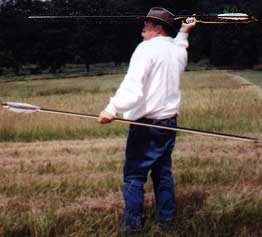
Atlatls are devices used to throw darts (spears). These devices were developed throughout the world by such civilizations as the Aztecs, Aborigines of Australia and Indonesia, the Incas, Inuits and many more. It is unknown exactly where the atlatl originated but archeological evidence shows that it has been in use for at least fifteen thousand years. It is possible that it was invented and reinvented many times over hundreds of thousands of years by countless cultures. The atlatl is a device that is used to lengthen the arm, adding a greater mechanical advantage than throwing a spear with one’s bare hands, which makes the darts able to fly much faster and with much more force, with less power provided by the thrower. Above is a picture of Robert Berg demonstrating the use of the atlatl.
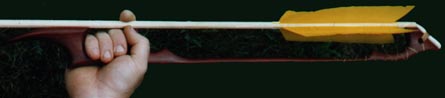
The atlatl is usually about 15″ to 30″ long, and on one end has a hook of some sort, and the other end has some sort of hand hold. The hook on the end of the atlatl is typically made out of bone, wood or horn, and is designed to connect to the back end of the dart. Each dart has a small dimple at the end that fits the hook. The dart lays parallel to the atlatl, and at the handle end it is held in place by the fore finger and thumb. Some atlatls, such as the one in the picture above have rests for the dart, others don’t. The varieties and types of atlatls are almost endless, and each has different features.

The atlatl is held in the thrower’s preferred hand, with the dart parallel to the atlatl. The thrower points the dart at the intended target, steps into the direction of the shot, while the end of the atlatl swings around in a flipping motion, pushing the dart forward. As soon as the cast is started, the dart is released by the fingers holding it, while the atlatl itself is retained in the hand. Centrifugal force keeps the spur in contact with the knock dimple. Then, it is simply a matter of following through until the dart leaves the atlatl. Many different types of throwing styles have been developed by different atlatlists but they all are something like this.
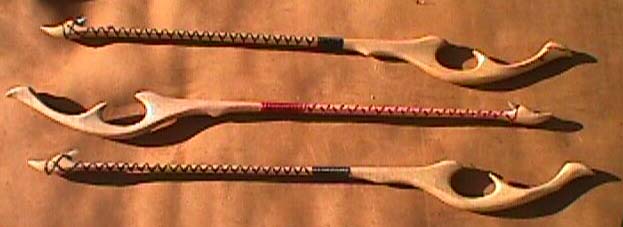
Atlatls and darts vary in size, shape, material and quality. There are as many styles of atlatls and darts as there are atlatlists. The equipment of atlatlists varies from the simplest stick-like atlatls to elaborate, decorated atlatls that are pieces of art as well as deadly weapons. Weights are often used both to decorate atlatls and to improve their stability, balance, and accuracy. No 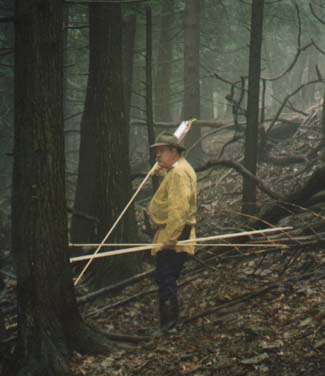 atlatl is complete without a good set of matchinng darts. Darts range from 5 feet to 8 feet, but average about six feet long. Competition and hunting darts tend to be longer. Usually, the longer the dart, the more accurate it is — but the longer it is, the shorter the distance is that it can be cast. Atlatls, darts and parts to them have been made from many different kinds of materials including, wood, metal, stone, bone and cane. (Check out Thunderbird’s many different designs) Each has its purpose, form following the function of each of the various designs.
Atlatls are used by many enthusiasts for both target shooting and hunting. Atlatl hunting is legal in several states, including Missouri, Alabama, Nebraska and Alaska, but the majority of states do not yet allow it. Wild Boars are most often hunted, but many animals, from Fallow Deer to Caribou have been killed by the atlatl in recent times. Many Atlatl enthusiasts are lobbying their state governments to legalize atlatl hunting and fishing just like bow and firearm hunting is allowed. If you live in a place where atlatl hunting is illegal, contact your local state legislature and voice your support for legalizing atlatl hunting and fishing.
For those of you who are not into the hunting or fishing aspects of the atlatl, there are dozens of atlatl contests held throughout the world (See the shows section). There also is a World Atlatl Association, which we encourage you to join. Among the many benefits of the World Atlatl Association is the news letter that will help keep you abreast of the latest information about atlatls and events in the world. They also keep track of the top atlatl scores throughout the world in a contest called the International Standard Accuracy Contest (ISAC) that measures the skill level of each contestant, relitive to all the other contestants.With more and more atlatlists taking their first throws every day, and ever increasing interest being expressed , the sport is one of the fastest growing pastimes around.
Thank you for reading this introduction to atlatls!
Written by Peter Berg, 1999.
Interesting that this primieval weapon was found to have been used on every continent except Antartica – maybe it was used there and we just haven’t found it yet, hmmmm?
In 1992 I took my 4 young sons on a vacation and was fortunate to meet with a Park Ranger in Texas who’s pasttime was throwing an atlatl. He was able to throw overhand, but also showed a side and underhand launch as well. Over hand didn’t work for me, but side and underhand sure did! By the end of our visit that day, my 9 year-old (at the time) was able to launch and stick a dart over 150 yrds into round bails of hay, set up as a target. The darts were less than 4′ long, as I recall, and made of aluminum. The Park Ranger said that it wasn’t the amount of force that was used, but the amount of follow through that made the difference. And, of course, practice.
Thanks for the articles. I have learned a lot reading your site.
Enjoyed reading the article on the Atlatl.
Thanx a lot for the info. I’m trying to make the atlatl popular in Bulgaria and as a matter of factIam the first in my country.Looking for supporters…
Good luck! Let us know if we can be any help.
I just used an atlatl today at my freinds house. I loved it !!!! So when i got home i spent an hour on my computer to figure out the name of this devise. When i found it i went on ebay and tried to find one i would buy. This is how I found your sight. I lovee atlatl.
Thank you. We would be happy to send you a catalog. Check the World Atlatl Association event schedule and come to an event.
Nice work. Thanks for your article.
Im Australian and have been familiar with the Australian Indigenous peoples ‘Atlatl’ since I was a kid. Theirs are called ‘Woomera’ and are used to throw a javelin style spear (no fletching) for hunting kangaroos, emus and fish. Sometimes also used in the occasional tribal war to throw spears and as a wepon unto itself. Made from very dense timber, treated with fire and resins and sometimes had sharpened edges or boulbous club heads… Ouch!
Thank you!
No way, you didn’t give me the info that i needed…I won’t buy one now!
Can you use them left handed
thanks for the information very helpful