The Development of Thunderbird Atlatl Hunting Darts

I have been making and using hunting darts for use with atlatls for a couple of decades. When a few friends and I started doing this in the early 90s we were aware of the fact that atlatls and darts must have been used for hunting in ancient times but we were unable to find information about how darts were made from living sources.

Determining the Diameter of Darts from the Archaeological Record
When I started designing atlatls and darts in the late 1980s I had very little to go by other than a few books and articles I read at the library. At the time there were few if any people with any atlatl hunting experience to ask how to do it. I found a few other people who were interested in the same task and so we joined forces. Who these alatl pioneers were, is the subject of another article.

Bob Berg of Thunderbird Atlatl has been developing equipment for atlatl hunting since the early 1990s.

We were left to gleaning information from the archaeological record. We started by looking at collections of projectile points that belonged to friends and museums. What we noticed was that there was a large variety of different sizes of points and point styles. We measured the space between the notches on many points and came to the conclusion that darts must have been anywhere from 3/8 to 5/8 inches at the point where they were hafted. Using these measurements, I started making darts of many different diameters.

Establishing the Ideal Diameter to Length Ratio of Darts
Deciding how long to make the darts was accomplished by starting with shafts that were 8 foot long and fletching them. I cut off 2 inches at a time from the front end and cast the darts and noted how far they flew by throwing them on a football field marked for yardage. From that experiment I worked out the optimal diameter to length ratio. Beginning at the small end of the spectrum I noticed that 3/8 inch darts made of hardwoods like maple, ash and cherry wood seemed to work best at lengths like 48 to 54 inches. At the large end of the spectrum darts of 5/8 inch in diameter seemed to work best from 80 to 90 inches long.

Experiments with Wood Types, Tapering and Heat Treating Dart Shafts
A good friend, the late Wendell Adams of Louisville KY helped me rig up a large belt sander to taper darts. We experimented with them on hunting trips in Florida, Georgia, Pennsylvania and Alabama, hunting wild boar with our experimental equipment. The tapered darts we were making at that time were quite difficult to make requiring a lot of hand work. From 2000 until last summer our standard hunting darts were a straight 9/16” by 7 feet ash weighing 8 ounces. We only made tapered darts for those who requested them. Two years ago I built a new dart tapering machine that requires less effort by the operator to rotate the darts.

Improved Hunting Darts
The new version of hunting dart flies better than our previous versions. They are made from pine, 7 foot long, tapered from 9/16ths to 7/16ths inch. They weigh about 6 ounces and have a spine of about 7 pounds. They are faster than the old 8 ounce ash darts but have better penetrating power than ultra-light darts. The pine darts tend to stay straighter than hardwood darts and require less maintenance time keeping them straight. Many of my atlat friends in Europe are using pine shafts, so I thought I would give it a try. Further experiments reveled that heat treating the darts improved stiffness. Experiments that I have done in the last few years, revealed new solutions to the complex problem of balancing weight, spine, taper and the type of wood used.

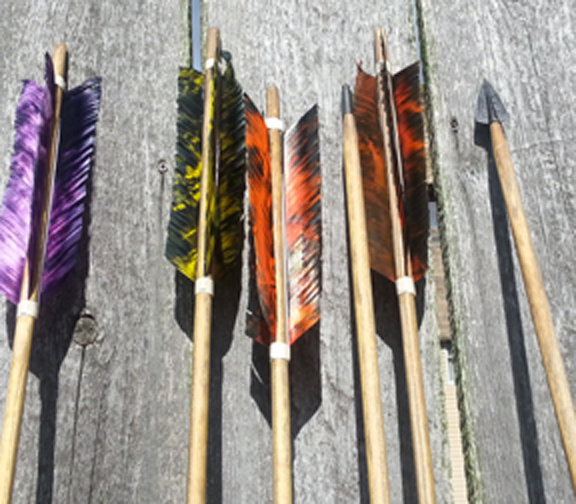
Seven foot hunting darts manufactured in the Thunderbird Atlatl shop. Darts are shipped with field points for practice. Hunting points are included in the package to be attached when ready for use.

Dart Points for Hunting and Practice
Thunderbird Atlatl darts have shaped tips designed to accept field points that can be easily switched to Ace Broadheads. This makes it possible to practice with the same set of darts that will be used for hunting. Our Thunderbird Atlatl dart tips are tapered to fit almost any traditional broadhead on the market so you are not forced to use a proprietary type of point you can only get from one source. If they break when you hit hard objects like rocks or trees, they usually break off just behind the dart point so you lose only 1/2 inch in re-tipping your darts.

The Future of Atlatl Hunting
I doubt that the last word on atlatl hunting darts has been written. It will be through the efforts of people like me who have an undying interest in atlatls, who will take on the task of re-discovering an ancient past through experiment and experiential archaeology. The future of atlatl hunting has been and will be forged by many people who will take up the task of learning the skills necessary to accomplish the goal that I and many of my friends, colleagues and customers have had, which is to develop atlatl hunting so it is universally accepted as one of the many choices that hunters can legally make. As for my own part, I produce atlatl hunting equipment that has evolved and improved over two decades and will continue to be improved.-Bob Berg

Making the Conical Copper Atlatl Dart Point

copper points
The conical copper points that are found in the Great Lakes area of the United States were originally produced by people from The Old Copper Culture. The copper “culture” began as early as 7000 years ago by some estimates so it is likely to have embraced many cultures over dozens of centuries. The conical copper point was used for the entire time so it must have been a very successful design. Not only are they a good design but the color of the copper is beautiful.

My experiments using this style of copper point have proven to me that they are also a very successful modern atlatl dart point design as well. An interesting quality of copper is that it work hardens. As you create the point it makes it very hard and resistant to damage. The tips of copper points will often bend but it is very easy to straighten them out even while you are afield using a couple of rocks; one as a hammer and the other as an anvil.

I have experimented with natural copper nuggets several times but it is rare and expensive to get so I use modern copper sheets to produce the conical copper points I make. The thickness of the copper I start with is usually 1/16” or thicker. I start by cutting triangles of copper with a tin snip that are about 2 ½” long by the diameter of the dart times three and one half. The next step is to hammer the three edges so they taper down to almost paper thinness. The reason for this is that in forming the cone the two sides need to overlap. I use a ball peen hammer and an anvil. In addition to these tools I use a mandrill and a wooden block with a half cone shape carved out that matches the mandrill shape.

After hammering out the edges I anneal the copper in a fire or in the flame of a torch. I then use the mandrill and wood block to begin rolling the cone, and then finish it by hammering the cone around the mandrill. The ancient Old Copper Culture People used mandrills hammered from copper. I use iron mandrills that I make on my metal lathe. I have also used temporary mandrills made of hardwood like Osage or Hard Maple.

Conical points have an added advantage in that they have a very large glue surface area which means that you can use traditional pine resin glue to fasten them onto your dart shaft.

I have had a few darts last several years without the copper points coming off. When copper points are new the tips are so pointy that they will penetrate as well as stone points or broadheads and it is very likely that people of the Old Copper Culture used conical copper points for hunting and fishing.

By Bob Berg

Where does the word “atlatl” come from? Thank Zelia Nuttal.

Zelia

One of the people we as atlatlists owe a great debt of gratitude to is Zelia Nuttal. She was a polyglot who used her mastery of several languages to discover and write about pre Aztec cultures in Central America. She had a working knowledge of Nahuatl the language of the Aztecs who dominated what is now central Mexico during the Late Postclassic period of Mesoamerican history.

Zelia Maria Magdalena Nuttall wrote an article in 1891 called “The Atlatl or Spear-thrower of the Ancient Mexicans”. It is very likely that the word “atlatl” was brought into the English language via her publication. Nuttal was born in San Francisco, on September 6, 1857 and died April 12, 1933. She was an American archaeologist and anthropologist, who specialized in pre-Columbian Mesoamerican manuscripts. She traced the Mixtec codex now called the Codex Zouche-Nuttall and wrote the introduction to its first facsimile publication (Peabody Museum, Harvard), 1902. She was educated in France, Germany, and Italy, and at Bedford College, London.

This is sourced from a Wikipedia article. –Bob Berg

Atlatl Dart Gift Certificates Available Right Up to Christmas!

Go to our online catalog and you will find gift certificates available from $10 to $250. Send us the information and we will email the gift certificate to you so you can give it in time for Christmas. Questions?, give us a call at 800-836-4520

Are you giving someone an atlatl or dart kit for Christmas or did you get one for yourself? Check out the photos below to see what some of our customers have done with their kits!
Photos-of-Customers-Kits

Procrastinators Specials! It’s not too late to get something before Christmas!

Looking of that last minute unique gift for that special someone? An atlatl set makes a great gift.

If you’ve been procrastinating, no problem – we are ready for you. Just give us a call and we can get your order out in a couple of hours.

The post office offers Priority Express mail for guaranteed delivery for Christmas. Priority mail is also available and should make it by Christmas but it’s not guaranteed.

We have a good supply of Catatonks, Catatonk Hunters, Wyalusings, wedge Kanakadeas and Kanakadea kits.

We have a good supply of seven foot tapered hunting darts which also make great target darts. There are also a wide variety of five and six foot darts.

We also have great stocking stuffers: our Atlatl Fever DVD, hafting glue, dart repair kits and more!

Call us at 800-836-4520 or email us at contact@thunderbirdatlatl.com and we will get your order out!

The world's foremost atlatl and dart outfitter