
What is an atlatl?
An atlatl (say “AT-lat-ul”) is a spear thrower: a handle with a hook or spur that casts a long, light spear called a dart. The atlatl works like an extra section of your arm, so you can throw the dart much farther and faster than by hand.
Spear-throwers are among the oldest hunting tools, and were invented independently by ancient humans all around the world. They pre-dated the bow and arrow in most regions. Here at Thunderbird Atlatl, we make modern interpretations of these ancient devices, inspired most heavily by spear throwers found in North and Central America.
Bob Berg explains the atlatl in about two minutes.
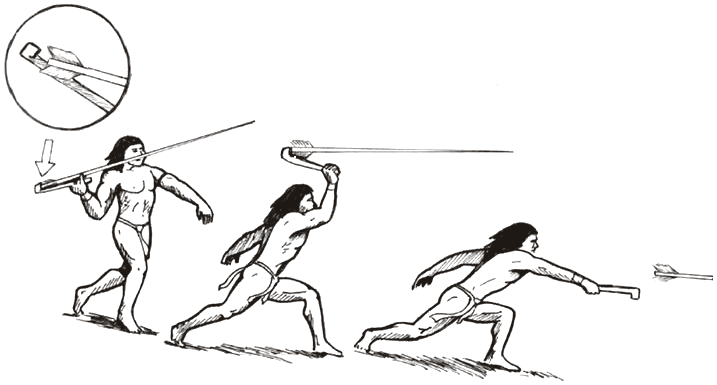
Why use a spear-thrower?
- An atlatl throws a dart about 3 to 4 times farther than a heavy spear thrown by hand, and much more accurately.
- It works best at 10 to 30 meters. Specialized light darts have gone as far as 250 meters.
- Darts run 3 to 9 feet and are made of wood, cane, bamboo, aluminum or graphite.
- People hunt deer, boar and fish with atlatls today, and compete in contests around the world.
Where the name comes from
“Atlatl” is the Aztec (Nahuatl) word for the spear thrower. People used them on every continent except Antarctica; in Australia it’s called a woomera. In North America, the bow and arrow overshadowed the atlatl only about a thousand years ago, and many cultures kept using both.
Atlatls in America · Where the word “atlatl” comes from
When and how were they used?
Spear-throwers date back at least 20,000 years, to the last Ice Age, and worn stone points from Belgium hint at 31,000. They have been used until modern day in many parts of the world.
People used them to hunt mammoths; to fight wars (like the Aztecs against the Spanish Conquistadors); and to hunt for seals, whales and fish from kayaks and canoes.
Who used spear-throwers?
Humans invented the spear-thrower again and again, all around the world. Here are some of them, from the Ice Age to today.
Early humans of South Africa
About 71,000 years ago
Spear-thrower: Unknown: maybe the very first spear-throwers
Tiny stone blades from Pinnacle Point cave tipped light, fast projectiles. Darts or arrows? The team that found them leans toward spear-throwers. The mystery: no actual spear-thrower has ever been found in Africa, and later African hunters chose the bow.
Ice Age hunters of France and Spain
About 23,000 to 12,000 years ago
Spear-thrower: propulseur (French for spear-thrower)
Reindeer-antler spear-thrower hooks around 20,000 years old are among the oldest ever found. Later artists carved spear-throwers into horses, ibex, even a mammoth: the same animals they hunted and painted on cave walls.
Ancient Greeks and Romans
About 700 BCE to 400 CE
Spear-thrower: ankyle (Greek) or amentum (Latin), the atlatl’s cousin
Not a stick but a leather thong wound around a javelin. Hook a finger in, throw, and the javelin spins off like a rifle bullet. Olympic athletes and Roman soldiers used it, and tests show it adds real distance.
Aboriginal Australians
Thousands of years ago to today
Spear-thrower: woomera (a Dharug word), with many names across Australia
The multi-tool of spear-throwers. In the deserts, one woomera could launch a spear, mix ochre paint, make fire and, with a stone blade set in the handle, carve wood. They’re still made and used today.
Sepik River peoples, New Guinea
Centuries ago into the 1900s
Spear-thrower: bamboo spear-thrower
A hollow length of bamboo, often topped with a carved figure. Warriors launched spears with them in battle, and the throwing motion helped a man keep his balance standing in a narrow dugout canoe.
Inuit of Greenland and the Arctic
About 1,000 years ago to today
Spear-thrower: norsaq (Greenlandic throwing board)
You can’t wind up for a big throw sitting in a kayak. The norsaq let a seated hunter fling a harpoon at a seal one-handed, with real speed. Greenland kayakers still make them and throw them in competitions.
Unangan, Alutiiq and Tlingit hunters, Alaska
Centuries ago into the 1900s
Spear-thrower: throwing board (Alutiiq: nuqaq)
From skin boats they threw darts at sea otters and seals. Tlingit throwing boards were carved with spirit figures like those on shamans’ rattles. Only about 25 are known to survive.
Old Bering Sea people, Chukotka
About 2,200 to 1,200 years ago
Spear-thrower: throwing board
On the Asian side of the Bering Strait, walrus and seal hunters launched ivory-tipped harpoons with wooden throwing boards. Their graves at Ekven and Uelen, more than 500 of them, hold walrus-ivory harpoon parts carved with swirling designs.
Kanak people, New Caledonia
Centuries ago into the 1900s
Spear-thrower: ounep (a throwing cord)
Not a stick but a cord. One end loops over a finger; the other hitches around the spear and slips off as it flies, adding thrust and keeping the spear on line. Captain Cook’s crew collected one in 1774.
Clovis hunters, North America
About 13,000 years ago
Spear-thrower: atlatl (their own word is lost)
Ice Age America’s big-game hunters, famous for beautifully fluted stone points. Many archaeologists think they launched those points at mammoths and bison with atlatls.
Basketmakers, American Southwest
About 1500 BCE to 500 CE
Spear-thrower: atlatl
Bone-dry caves preserved their atlatls, darts, stone weights and even the leather finger loops. Arizona’s White Dog Cave held two complete atlatls and three darts. Around 500 CE, the bow and arrow took over.
Archaic peoples, eastern North America
About 8000 to 1000 BCE
Spear-thrower: atlatl
For thousands of years, from Kentucky to New York, people hunted deer with atlatls. At Indian Knoll, Kentucky, some were buried with their atlatls; the antler hooks survived. In much of the East the bow didn’t take over until around 600 CE.
The atlatl comeback
Since the 1980s
Spear-thrower: atlatl, the Aztec word, now used worldwide
Hunters, teachers and history buffs brought the atlatl back. The World Atlatl Association began in 1987, contests run across North America and Europe, and Thunderbird Atlatl has made atlatls in Candor, NY, since 1990.
Aztecs (Mexica), central Mexico
1325 to 1521 CE
Spear-thrower: atlatl (their word, in Nahuatl)
Legend says the god Opochtli invented it. Aztec warriors hurled atlatl darts at Cortés’s conquistadors in 1519–21; the Spanish said they could pierce armor. But darts were no match for smallpox, or for Cortés turning the Aztecs’ enemies into allies.
Teotihuacan and the Maya
About 100 BCE to 900 CE
Spear-thrower: atlatl
Teotihuacan warriors made the atlatl a symbol of power. In 378 CE a stranger from Teotihuacan arrived at the Maya city of Tikal. A year later a new king took over: the son of a ruler archaeologists nicknamed Spearthrower Owl.
Inca Empire, the Andes
1438 to 1533 CE
Spear-thrower: estólica (the Spanish name for Andean spear-throwers)
Slings were the Incas’ favorite, but their armies also hurled darts with spear-throwers, tipped with fire-hardened wood, metal or fish spines. Battles opened with slingers, then archers and spear-throwers, then the clubs came out.
Moche, north coast of Peru
About 100 to 800 CE
Spear-thrower: estólica (the Spanish name for Andean spear-throwers)
Spear-throwers were the Moche’s main long-range weapon. Nobles in fancy costumes staged ritual deer hunts with darts and spear-throwers, and potters painted the scene again and again. One surviving grip is carved as a little deer.
Kamayurá and neighbors, Upper Xingu, Brazil
Recorded since the 1940s; still held today
Spear-thrower: spear-thrower
In the Jawari ritual, held to honor the dead, men from different villages face off in a duel with spear-throwers and darts. Part funeral, part sports tournament, and still going today.
Hover over a glowing spot on the map or a name below it (on a phone, tap). Dates are approximate, and archaeologists still debate many of them.
Try one
The easiest way to start is a starter set: an atlatl and three darts, ready to throw. The Kanakadea’s “Y” rest holds the dart for you, so beginners and kids can focus on aiming.
Atlatl history and archaeology
Where the atlatl came from, how people used it, and the myths Bob has spent years setting straight.
-
Atlatl Myths
The atlatl and dart are mythically endowed with powers that are highly overrated by several atlatlists. The first myth is that the dart flexes and compresses, storing energy…
-
Atlatls in America: A Brief Overview
The word “atlatl” is the Aztec word for spear thrower. Our history in North America was greatly affected by the Native Central Americans’ use of the atlatl. Bernal…
-
Bannerstones and how they relate to the Atlatl
An Argument Against the Notion That Bannerstones are Atlatl Weights The following is a recently updated article on bannerstones written and researched by Robert S. Berg of Thunderbird…
-
First use of atlatl in 1871? Dictionary definition needs refining
We came across this definition of atlatl in an online dictionary the other day. The dictionary lists the origin of the word atlatl from the Nahuatl language but…
-
History of the Fingerless or “Y” Atlatl
Prior to 1990 or so I came up with a design for an atlatl that later turned into the “Wyalusing” It was the first atlatl ever recorded to…
-
Melting Ice Sheet Reveals 10,000 Year Old Atlatl Dart
Pictures and stories were all over this week of a 10,000 year-old atlatl dart which showed up after an ice sheet melted near Yellowstone National Park. Craig Lee…
-
Southwestern-Style Spear Throwers Identified in the Ozarks
An atlatl fragment has recently surfaced that was discovered in the Ozarks in Missouri, as reported by Western Digs. New analysis of two spear-throwers excavated nearly a century…
-
Where does the word “atlatl” come from? Thank Zelia Nuttall
One of the people we as atlatlists owe a great debt of gratitude to is Zelia Nuttall. She was a polyglot who used her mastery of several languages…